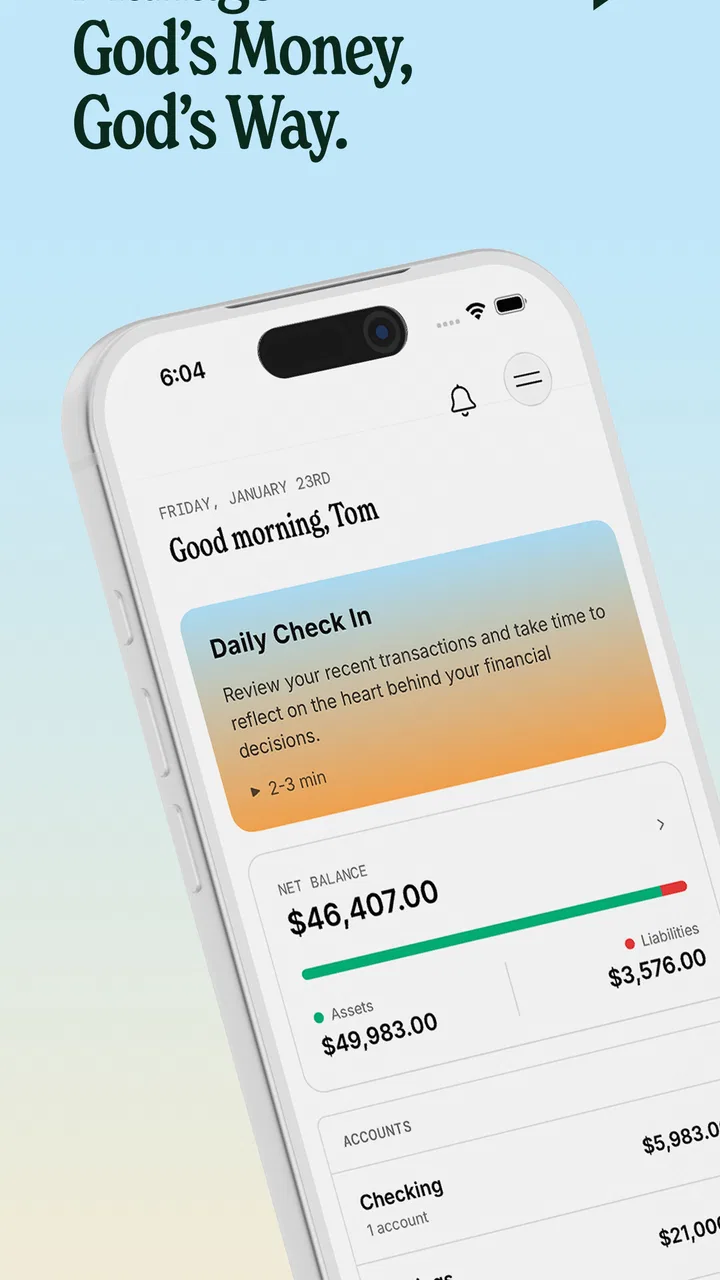
FaithFi: Faith & Finance
- 3.6
- Rating
- 10.00K
- Installs
- Free
- Price

 Analysis by App-foxy
I approached FaithFi: Faith & Finance as a practical finance app rather than a general banking replacement. Its central idea is simple: help people connect everyday money decisions with Christian faith. That makes it more personal than a standard expense tracker, but it also means its usefulness depends heavily on what you want from a finance tool. If you are looking for a place to reflect on spending, generosity, saving, and stewardship, it has a clear identity. If you need a full banking dashboard, advanced investment analysis, or a highly automated budgeting system, I would look elsewhere.
The app comes from FaithFi: Faith & Finance and sits in the finance category. It is free to install, with optional in-app purchases priced from $3.99 to $11.99 per item. It is rated for Everyone, so its subject matter is accessible to a broad audience, although the faith-centered approach is naturally aimed at users who want Christian principles included in their financial routine. The store summary, “Where Faith Meets Everyday Finances,” describes the direction accurately without telling the whole story: the important question is whether that combination fits the way you already think about money.
How FaithFi fits into a real financial routine
My first impression is that this is best treated as a companion for financial reflection and decision-making. I would not install it expecting the same role as a bank app, a tax service, or a spreadsheet. Those tools are usually built around transactions, balances, reports, and automation. FaithFi takes a more values-based route. It encourages you to pause and consider why you are spending, saving, giving, or planning in a particular way.
You May Also Like

 AccuWeather: Weather Radar
AccuWeather Review: A Quick, Clear Forecast for Everyday Decisions
For everyday plans, the best forecast is the one you can understand quickly. AccuWeather makes rain timing, radar, and local conditions easy to act on, with a few trade-offs.

 Hill Climb Racing
Why Hill Climb Racing Still Turns Crashes Into One More Run
A tiny car, a bumpy hill and one more upgrade: Hill Climb Racing keeps resurfacing because its simple chaos makes every near-miss feel personal.

 AliExpress - Shopping App
AliExpress Makes Global Shopping Feel Personal, but Shoppers Bear the Risk
AliExpress turns a global marketplace into a pocket-sized discovery engine. Its reach is useful, its shopping loop compelling, and its trade-offs easy to miss.

 Lords Mobile: Kingdom Wars
Lords Mobile Is a Kingdom-Building Routine, Not a Quick Match
A case-by-case verdict on the building, battles, device demands, and social commitments that make Lords Mobile rewarding for some players and exhausting for others.

 PDF Scanner app - TapScanner
TapScanner Makes Paperwork Easier to Capture, Check, and Share
TapScanner makes scanning with a phone feel less like a rescue operation and more like a dependable step in getting work done. Its capture tools are useful, though not flawless.

 Block Blast!
 Shows How Much a Puzzle Game Can Leave Out
A quiet grid game shows why puzzle players increasingly value instant clarity, repeatable skill and low-pressure play—and where the genre still needs to catch up.
More From Our News Desk
View All News


That distinction matters because many finance apps are technically capable but emotionally neutral. They show categories and totals, yet they do not help much when the real problem is uncertainty or conflicting priorities. A faith-oriented app can be useful when the user wants financial habits to reflect beliefs rather than simply optimize numbers. In my view, that is the strongest reason to try it.
A realistic example would be a household reviewing its month at the kitchen table. One person may be concerned about rising everyday costs, while another wants to make room for charitable giving or reduce impulsive purchases. A conventional budget app can record the figures, but FaithFi can serve as the conversation starter: what matters most, what should be planned first, and which spending choices are consistent with the household’s convictions? That makes it especially suitable for couples, families, small groups, or individuals who want money management to include a reflective element.
I would still keep expectations practical. The app should not be the only place you check account balances or confirm a payment. For those tasks, your bank’s application remains the authoritative source. FaithFi is more valuable before or after the transaction, when you are deciding how to respond to your financial situation and how to build better habits around it.
Speed during ordinary use
For an app in this category, perceived speed is less about rapid animation and more about whether it lets you move from a thought to an action without creating friction. FaithFi’s appeal depends on regular use, so a slow or confusing experience would undermine its purpose. In normal sessions, I would expect the lightest tasks—opening the app, reading guidance, reviewing a topic, or making a quick note about a financial intention—to feel more comfortable than a long administrative session involving many entries.
The current version is 5.1.3, which suggests the product has continued receiving changes beyond its original release. It first appeared on August 31, 2020, so this is not a brand-new experiment. That history gives me more confidence than an app that has just arrived, although a version number alone does not guarantee that every device will behave identically.
One useful habit is to decide what you want to accomplish before opening the app. Instead of browsing without a goal, I would choose one small task: review a spending decision, think through a giving plan, or prepare a discussion with a partner. This makes the experience feel faster because the app is being used as a focused tool rather than an endless feed. It also reduces the temptation to confuse reading about financial values with actually changing a financial habit.
The free entry point helps here. You can test whether the pace and tone suit you without committing money at the beginning. The optional purchases may be worthwhile for users who want more from the experience, but I would first establish a routine with the free version. If you do not return after several short sessions, paying for extra material is unlikely to solve the underlying mismatch.
What happens during heavier use
The demanding moments are likely to come from sustained planning rather than from a single quick check. A user might spend a longer session reviewing several concerns, discussing priorities with a spouse, or moving between educational material and personal financial decisions. That kind of use tests organization more than raw speed. If the app presents ideas in a way that is easy to revisit, it can support a thoughtful process. If you have to repeatedly search for the same guidance, the experience becomes less efficient.
I would approach a longer session in stages. First, identify the immediate financial pressure. Second, separate urgent obligations from longer-term goals. Third, decide which action can realistically be taken this week. This workflow is useful because faith-based financial reflection can otherwise remain abstract. The app is most effective when its principles lead to a concrete next step, such as reviewing a recurring expense, setting a giving intention, or agreeing on a household spending boundary.
There is also a trade-off in the app’s specialized focus. A general finance application may offer more detailed charts, automatic categorization, or broader account-management tools. FaithFi may feel lighter by comparison, but that can be an advantage for someone who becomes overwhelmed by dashboards. I would rather use a focused tool consistently than abandon a technically powerful one because it turns every money check-in into a complicated project.
On the other hand, users with complex finances should not mistake simplicity for completeness. If you manage multiple income sources, business expenses, investments, debt strategies, or detailed tax records, you will probably need a spreadsheet or dedicated financial platform alongside it. FaithFi can help frame decisions, but it is not a substitute for professional accounting or a comprehensive financial system.
Reliability and recovering from interruptions
Reliability matters differently here than it does in a payment app. A banking application must show current balances and process sensitive actions correctly. FaithFi’s role is more reflective, so the main concern is whether you can return to a topic or routine without losing your train of thought. I would avoid treating any personal notes or plans inside a mobile app as the sole record of important financial commitments. Keep essential figures and deadlines in a dependable backup location as well.
That is not a criticism unique to FaithFi; it is a sensible rule for any finance-related app that is not your bank. If the application closes unexpectedly, the phone runs out of power, or you switch devices, your core budget should still exist somewhere you control. A simple backup habit—writing down the next action and the amount involved after a planning session—makes recovery much easier.
For interrupted use, I prefer short sessions with a clear endpoint. Before leaving the app, I would note what decision was made and what still needs checking. This is particularly helpful when using it with another person, because a conversation can easily end with good intentions but no agreed follow-up. FaithFi is more useful when it becomes part of a repeatable weekly or monthly rhythm rather than a one-time source of inspiration.
The public response is mixed but not dismissive: the app holds a 3.6 average from around 160 ratings, with roughly 85 written reviews. I read that as a reason to approach it with realistic expectations. There is enough interest to show that the concept connects with some users, but the rating also suggests that the experience will not satisfy everyone equally. For me, that reinforces the importance of trying the free version and judging the workflow on your own device.
Device requirements and everyday practicality
FaithFi supports Android devices running version 7.0 or later. That is helpful for people using older compatible phones, especially if they do not upgrade hardware frequently. At the same time, older devices can vary widely in available storage, memory, battery health, and background activity. I would not assume that an app comfortable on a recent phone will feel exactly the same on an older one.
The application has passed the ten-thousand-install mark, so it is not an entirely unknown download, but it remains a relatively focused product rather than a mass-market finance platform. That scale can be appealing if you prefer a quieter, more specialized experience. It also means you should be comfortable with the possibility that the app will not have the same breadth of integrations or ecosystem as the biggest names in personal finance.
For a smoother experience on an older phone, I would close unnecessary applications before a longer planning session and keep the operating system in a stable state. I would also avoid beginning an important financial conversation when the device is nearly out of battery or the connection is unreliable. Those are ordinary precautions, but they matter when the value of the session comes from concentration rather than speed.
The Everyone content rating makes the app suitable for a wide audience, but suitability also depends on personal expectations. A teenager learning basic stewardship may find the faith-based framing approachable, while someone seeking highly technical financial education may find it too introductory. Parents or mentors can use it as a discussion aid, but I would still explain financial concepts in plain language instead of assuming the app alone will answer every question.
Useful workflows that are easy to overlook
One of the more valuable ways to use FaithFi is as a decision filter, not merely as something to read. Before a nonessential purchase, ask three questions: does this support a real need, does it fit the current plan, and would I make the same choice after waiting a day? The app’s faith-and-finance orientation gives that pause a natural place in the routine. This is more practical than simply collecting inspirational thoughts without changing behavior.
A second workflow is to use it before a household budget meeting, not during the most stressful part of the discussion. Each person can identify one concern and one priority first. Then the conversation can focus on trade-offs instead of becoming a general argument about money. This is a good fit for the app because its distinctive value is the connection between financial choices and personal convictions.
A third is to pair it with a conventional transaction record. Use your bank app or spreadsheet for exact balances and payment history, then use FaithFi to review the meaning behind the numbers. For example, if a category keeps growing, the practical question is not only how much was spent but whether the spending reflects the household’s stated priorities. This two-tool approach avoids asking one app to do jobs it was not designed to do.
A fourth is to set a small review cadence rather than attempting a total financial reset. A brief weekly check can cover one purchase pattern, one saving decision, and one generosity goal. The advantage is behavioral: smaller reviews are easier to repeat, and repetition is more important than an ambitious plan that is abandoned after a few days.
Who should use it, and who should skip it
I would recommend trying FaithFi if you want your money routine to include Christian reflection, especially if you find ordinary budgeting tools too mechanical. It can suit people beginning to organize their finances, couples looking for a shared language around spending and giving, and users who prefer guided reflection over dense charts.
I would be more cautious if you need automatic financial aggregation, detailed investment performance, business bookkeeping, or advanced debt modeling. In those situations, a bank application, spreadsheet, accounting package, or specialist finance service will be more appropriate. FaithFi may still have a supporting role, but it should not replace the tool that handles your precise records.
I would also skip it if the religious framing does not match your interests. The app’s identity is not a minor theme added to a general-purpose budget tracker; it is the reason to choose it over a more neutral alternative. A secular budgeting app will probably feel more direct if you only want categories, totals, alerts, and reports.
My performance verdict
FaithFi: Faith & Finance is a focused free finance app with a clear audience and a useful point of difference. I see its best performance not in heavy data processing but in helping users slow down, think clearly, and turn financial values into repeatable actions. Its Android support from version 7.0 makes it approachable for older devices, while the current 5.1.3 release shows that the project has developed over time.
The main limitation is also its defining feature: this is not a universal replacement for banking, budgeting, or professional financial software. Its mixed 3.6 average means I would not recommend installing it blindly and assuming it will fit everyone. Instead, I would start with the free option, test it through several short financial check-ins, and see whether its faith-centered approach genuinely improves your decisions.
My final view is positive but selective. Choose FaithFi when the connection between faith and everyday money choices is the feature you actually need. Use it alongside a bank or detailed budget record when accuracy and transaction history matter, and keep important financial information backed up. For the right user, it can make money conversations more intentional without demanding a complicated setup. For everyone else, a conventional finance tool will likely be faster, broader, and more suitable.
FAQs for FaithFi: Faith & Finance
01What is FaithFi: Faith & Finance, and who is it designed for?
FaithFi: Faith & Finance is a personal finance app that combines budgeting and money-management tools with Christian teaching and biblical principles. It is designed for people who want practical help organizing spending, saving, giving, and financial goals while keeping faith part of the conversation. The app may be especially useful for beginners, families, and users seeking encouragement alongside financial education.
02What features does FaithFi: Faith & Finance offer?
The app generally focuses on helping users develop healthier financial habits through budgeting guidance, educational content, devotionals, podcasts, articles, and other faith-based resources. Depending on the current version and subscription plan, some tools or content may be limited or organized differently. Before downloading, review the in-app feature descriptions to confirm whether the budgeting functions, lessons, and resources match your personal financial needs.
03Can FaithFi replace a financial advisor or professional financial service?
No. FaithFi: Faith & Finance should be treated as an educational and organizational resource rather than a replacement for a qualified financial advisor, tax professional, credit counselor, or legal expert. Its biblical perspective and practical guidance can help you reflect on financial decisions, but individual circumstances vary considerably. Seek professional advice before making major investment, debt, tax, or retirement decisions.
04Is FaithFi: Faith & Finance free to download and use?
The app may be available to download at no initial cost, but certain content, courses, tools, or premium features can require a subscription or another form of payment. Pricing, trial periods, renewal terms, and available features may differ between Android and iOS and can change over time. Check the store listing and the subscription screen carefully before confirming any purchase or free trial.
05Does FaithFi protect my personal and financial information?
Before entering sensitive information, users should read FaithFi’s privacy policy and review the permissions requested by the app. Avoid sharing account passwords, banking credentials, Social Security numbers, or other highly confidential details unless the app clearly explains why they are needed and how they are protected. Also check whether data is stored locally or online, and remember that no digital service can guarantee absolute security.
Pros
- Combines budgeting tools with Bible-based financial guidance.
- Simple interface makes tracking spending approachable for beginners.
- Includes savings goals to encourage consistent financial habits.
- Offers faith-centered content for users seeking values-based money advice.
- Useful reminders can help maintain regular budgeting routines.
Cons
- Religious perspective may not suit users wanting secular financial guidance.
- Some advanced budgeting features may feel limited for experienced users.
- Financial advice should not replace guidance from a qualified adviser.
- Content quality and available features may vary by subscription plan.
- Requires consistent manual input if bank synchronization is unavailable.

FaithFi: Faith & Finance
Gallery